Sound leaves no evidence. There’s no stain on the ceiling — nothing you can point at and say there. An apartment can seem silent at noon and wake me at 2 a.m., when a bass note comes through the wall, too faint to justify a complaint but enough to keep me awake. What got to me was having no control over it: someone else could ruin my next day without even knowing.
For years I tried the usual arsenal: earplugs, white noise, therapy, bargaining with neighbors. Nothing worked. Actual silence is rare when you rent in a city.
Suffice to say, I did not jump to designing a soundproof sleep capsule right away.
Pillows on the Bathroom Tiles
Wind didn’t bother me. But if a human made the noise — a hot spike of adrenaline.
I stopped trusting daylight viewings. Before signing a lease, I’d ask realtors to let me sleep there for a night.
One night stands out. I found a spacious apartment near a park that seemed perfect — until 11 p.m., when the building’s central heating pipes began to vibrate. A low, periodic hum seeped into the walls, the bedframe, my chest. I waited for it to stop. It didn’t.
Eventually I dragged my bedding onto the cold bathroom tiles — the only room without dedicated heating — queued a ten-hour “Brown Noise” track, and tried to convince myself this was fine. Looking from the toilet bowl to my pillow, I wondered how I ended up here.
The Half-Ton Hypothesis
If I couldn’t control the building, maybe I could control the boundary between it and my bed. The plan was to solve this mechanically, once and for all.
Recording studios solved this decades ago. The question was whether I could could fit studio-grade isolation into a renter-friendly enclosure around a bed. I grabbed the industry bible of studio construction, and immediately learned I had a lot of misconceptions.
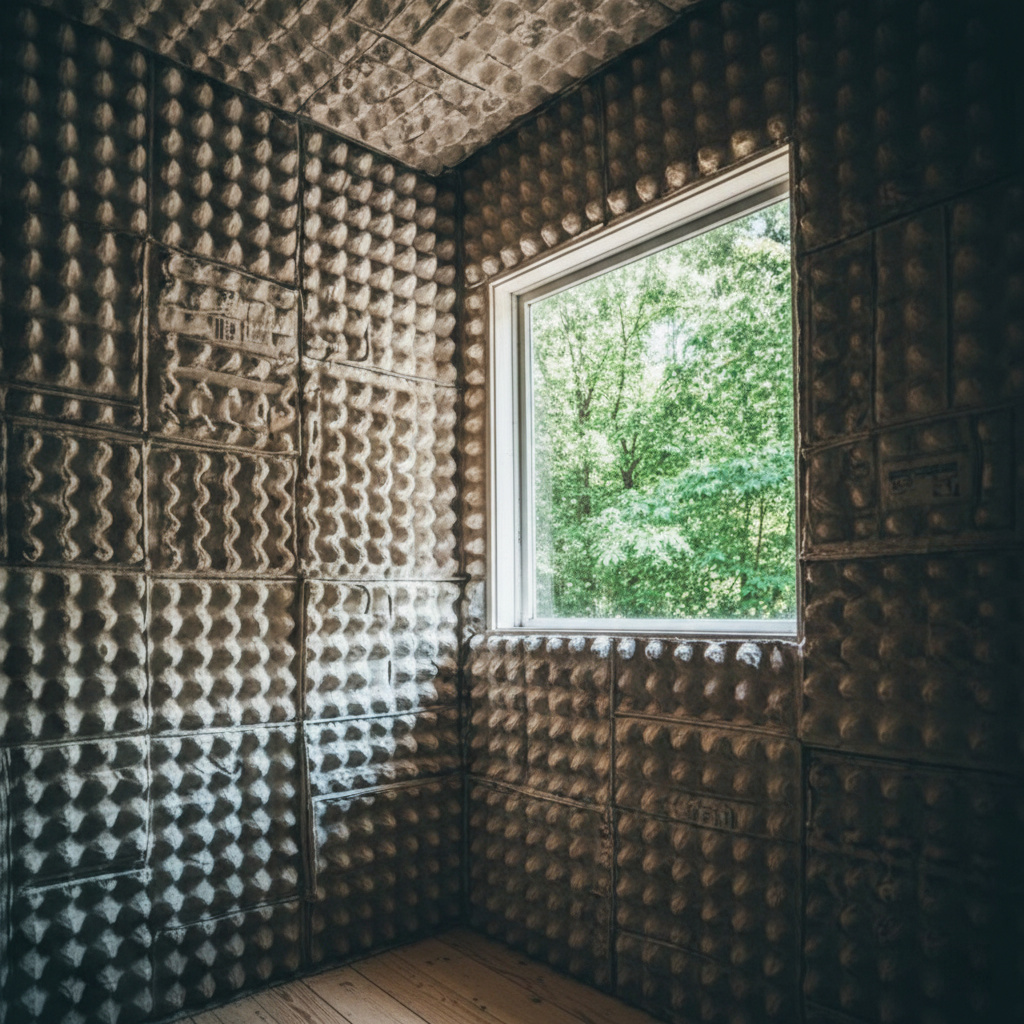
My mental image was egg cartons and acoustic foam — the YouTube studio look. But that stuff is absorption: it reduces reflections and makes a room less echoey. What I needed was isolation: stopping my neighbor’s bass from reaching my pillow. Foam barely matters there; low-frequency energy just plows right through.
Bass was the target—the hardest to stop, and my main sleep problem. A bass note really does vibrate a cement wall. The amplitudes are nanometers, invisible, but enough: the whole slab rocks back and forth like a piston, re-radiating the bass on the other side. Higher frequencies I could solve with earplugs and closed windows.
To stop low-frequency waves, acoustical engineering offers only two expensive tools: mass and decoupling. Mass is brute force: a heavier wall is harder to shake, the same way it’s harder to push a parked truck than a shopping cart. Acousticians call this the mass law. Double the wall’s mass, and you gain about 6 dB1 of extra isolation — noticeable, but not dramatic.
There’s a deep unfairness in acoustics: making noise costs nothing, but stopping it costs a fortune. Blocking an ordinary footstep can require hundreds of kilograms of material.
Decoupling separates the inner structure from the outer one so vibrations lose their rigid path. Hold a tuning fork in the air and it hums quietly; press it against a table and the whole surface becomes a speaker. Decoupling tries to preserve that separation.
Studios often use a “room within a room.” The inner shell sits on rubber pads and doesn’t touch the outer walls, floor, or ceiling. That made me wonder whether the inner room could be only large enough for a bed.
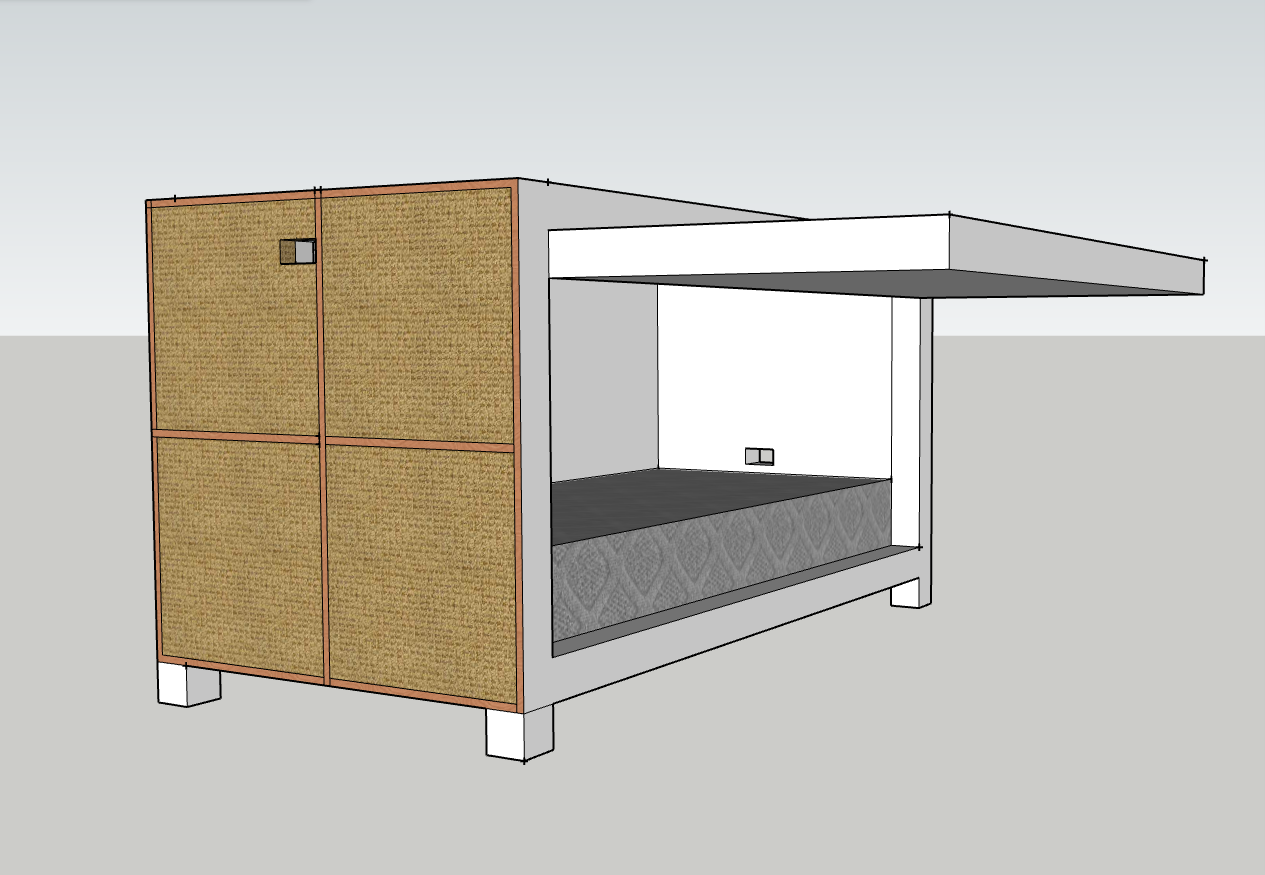
Once the requirements took shape, I hired Fehim (an engineer I found on Upwork) because I didn’t actually know how to design physical objects at this scale. The mass needed for real attenuation (reduction) pushed the estimate past half a ton.
A 100 kg door is a crushing hazard. The simple rectangle in my sketch translated physically into a massive lever arm destined to rip its hinges out — or tip the whole structure.
You don’t just “hang” a slab of mass-loaded vinyl (a thin, dense rubber sheet) and plywood; you build a steel cage to contain it. At that point, I realized how much structural engineering the design required.
I’d assumed plywood, drywall, and mineral wool were “cheap.” They are, until you need a lot of them. Fehim pushed for a prototype first. I’d somehow become the “perfect on the first try” client, and he had to talk me into cutting scope. I’m glad he did.
No Uncutting a Board
The next constraint was ventilation.
A sealed box might be quiet, but it’s also a coffin.2 Ventilation requires openings, and even a tiny gap can sharply reduce sound isolation.3
So the project stopped being “build heavy walls.” It became “build heavy walls and somehow let air in.”
Grime accumulation, emergency exit… Hermetic seal? A submarine CO₂ scrubber? My project folder kept growing. But everything else would matter only if I could get the walls right.
I started with a half-meter prototype cube with heavy, decoupled double walls.4 I bought mineral wool for the cavities, but after realizing the hair-thin glass fibers would coat my apartment, I stuffed them with old clothes instead. The prototype’s purpose was to test whether the wall assembly measurably reduced sound.
I didn’t have the tools, so I asked in a local chat. A stranger — Alex (thank you!)—offered his backyard and his workshop, helped source materials, and taught me a few saw tricks on the spot. Without him, the cube might’ve stayed a sketch.
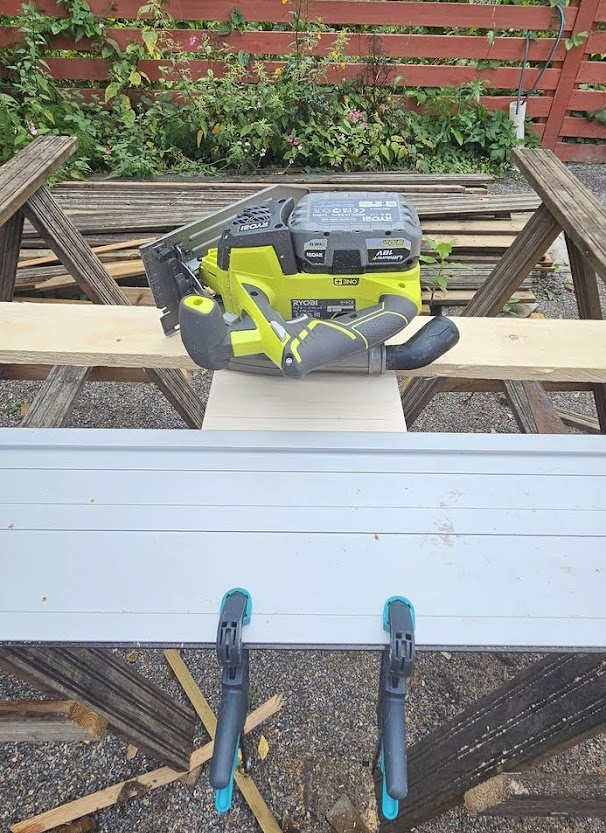
I assumed a plywood cube would be trivial. I hadn’t accounted for blade thickness, wood knots, or how quickly small errors accumulate until your “square” box needs quotation marks. Every correction removes more material — there’s no uncutting a board.
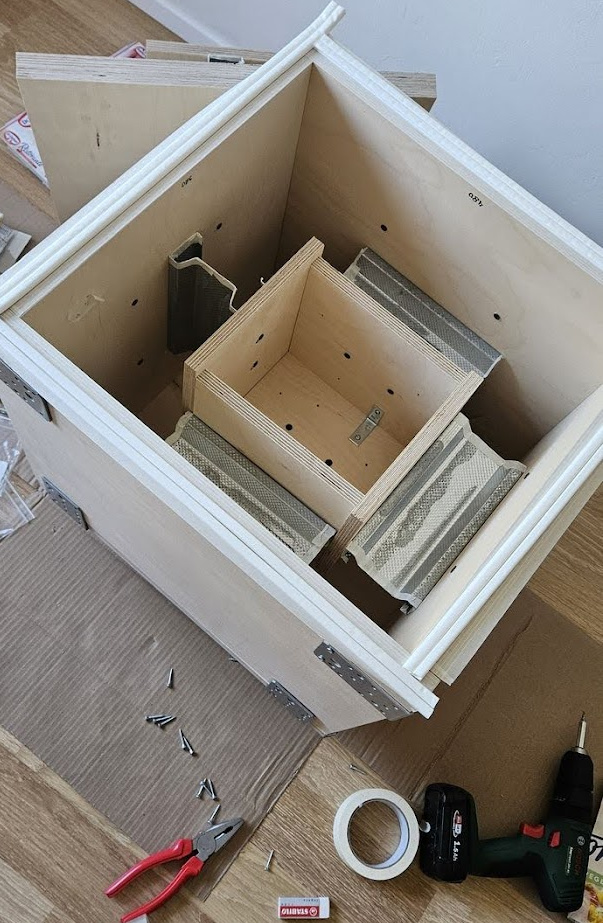
With the cube built, I set up a calibrated Dayton Audio mic and a flat-response speaker at 85 decibels (sound pressure level),5 played pink noise — a signal that hits every frequency at equal loudness — and recorded. Then I placed the mic inside the cube, played the same noise, and compared.
Subtract the two curves and you get the cube’s sound transmission loss (TL): how many decibels it blocked at each frequency. Everything above zero means the cube blocked sound. Below zero means it amplified it.
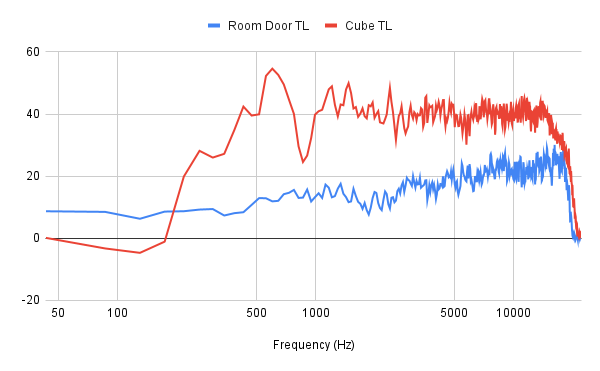
This wasn’t a lab-grade measurement. The test room had its own reflections and modes. But the result was unambiguous enough.
I wanted to slam the laptop shut.
At the low frequencies I cared about, the cube was ~10 dB1 worse than no cube at all. It was acting like the body of a guitar, resonating with the bass instead of blocking it.
At first I blamed my construction, then my testing setup. Later, theory explained one of the dips: at certain frequencies, the sound waves bounced back and forth inside the cube at exactly the right spacing to reinforce each other — like pushing a kid on a swing at just the right moment. The cube’s internal dimensions were accidentally tuned to amplify the very frequencies I wanted to block.6 I never figured out the second, sub-300 Hz dip.
After that graph, I avoided the designs for weeks. I started to doubt that a full-size capsule was realistic.
In retrospect, the pivot to metamaterials was partly genuine curiosity and partly a refusal to sit with the failure.
Thousands of Tiny Bottles
I started looking for a way to reduce the amount of plywood. That search led me to acoustic metamaterials — materials whose behavior comes less from what they’re made of and more from how they’re shaped.
Jet engines can’t be sealed, so some use honeycomb structures containing thousands of small Helmholtz resonators tuned to specific frequencies. A Helmholtz resonator is simpler than it sounds: blow across a bottle top and you hear a note. That note is the air in the neck bouncing against the air trapped in the body, and the bottle absorbs energy at exactly that frequency. Change the bottle’s shape, change the frequency it eats. Now imagine thousands of precisely shaped “bottles” embedded in a wall — each one swallowing a different slice of the noise spectrum.
The papers kept returning to the possibility of attenuation with less mass. I wanted to know whether geometry could replace some of the plywood. One paper (Hedayati et al., 2024) had enough data for me to reproduce the build.
This led to a delightful detour into parametric CAD — design software where every dimension is a variable you can tweak, then regenerate the whole model. Unlike the cube, this could iterate without sawdust: tweak a dimension, regenerate, print again. I ended up building a parametric generator and 3D-printing an array of Helmholtz resonators.
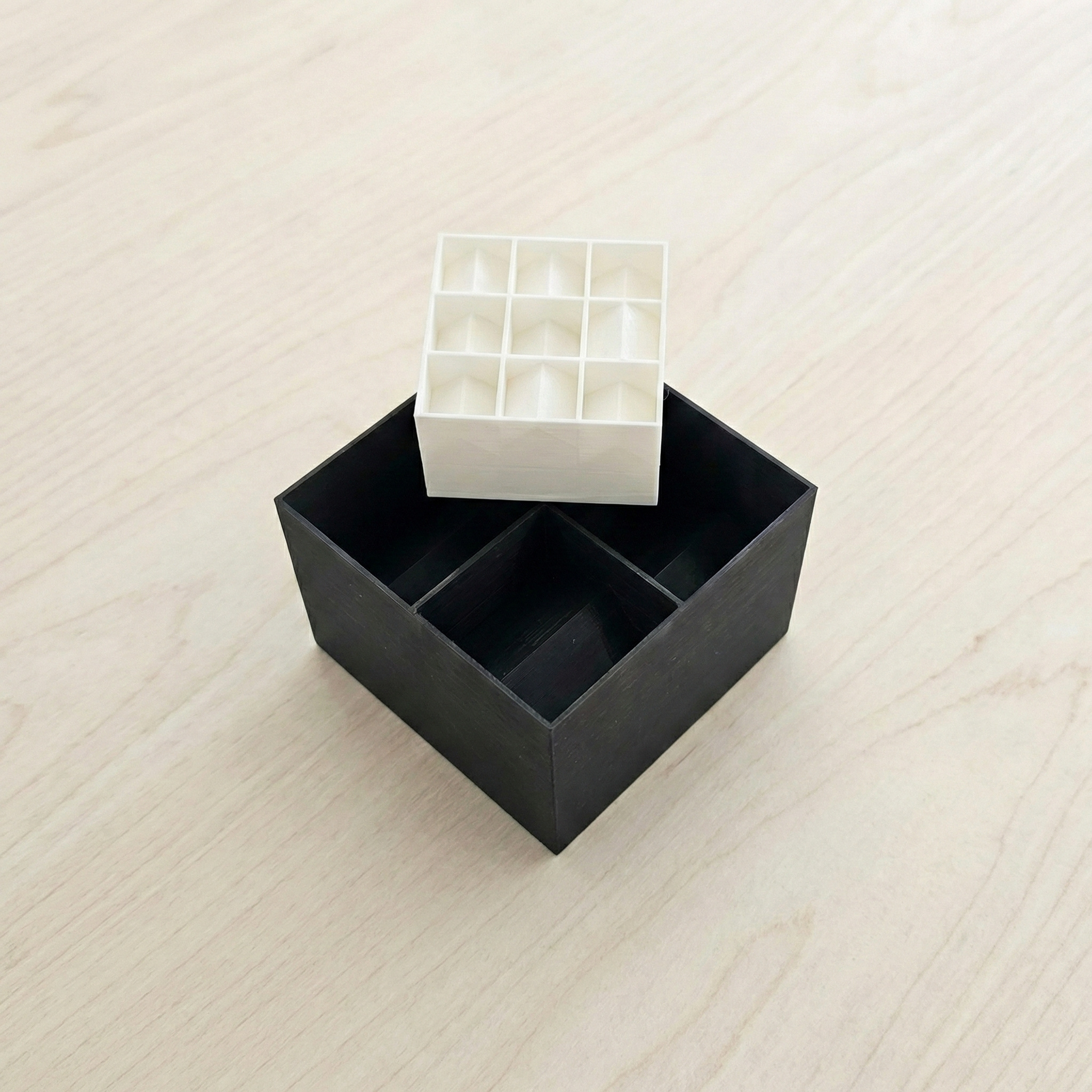
Holding the first print felt like a victory. Then I did the math. To cover a capsule, I’d need hundreds. Filament cost and print time ballooned into months. I never tested a single one. The prototype now holds spent batteries on my shelf.
The Last Paper
Then I found a paper by Krasikova et al. (2023). The authors used plastic plumbing tubes with cut holes to create paired Helmholtz resonators and reported attenuation across a broad range. Most metamaterials target narrow bands, such as a specific engine frequency; this design covered a broader range and did not even require a hermetic seal. Hurray!
I emailed the author with clarifying questions (she replied!). Plastic tubes were light, cheap, and targeted the needed frequency range. For the first time in months, the project looked buildable again.
After three months and six emails, I was ready to build. I opened a spreadsheet to finalize the Bill of Materials.
Each resonator tube needed a specific length to target a particular frequency. To cover a bed-sized enclosure — say, 5 meters of perimeter and 1 meter tall — I’d need six resonators per block, eight blocks per meter of wall. The total was 250 meters of PVC.
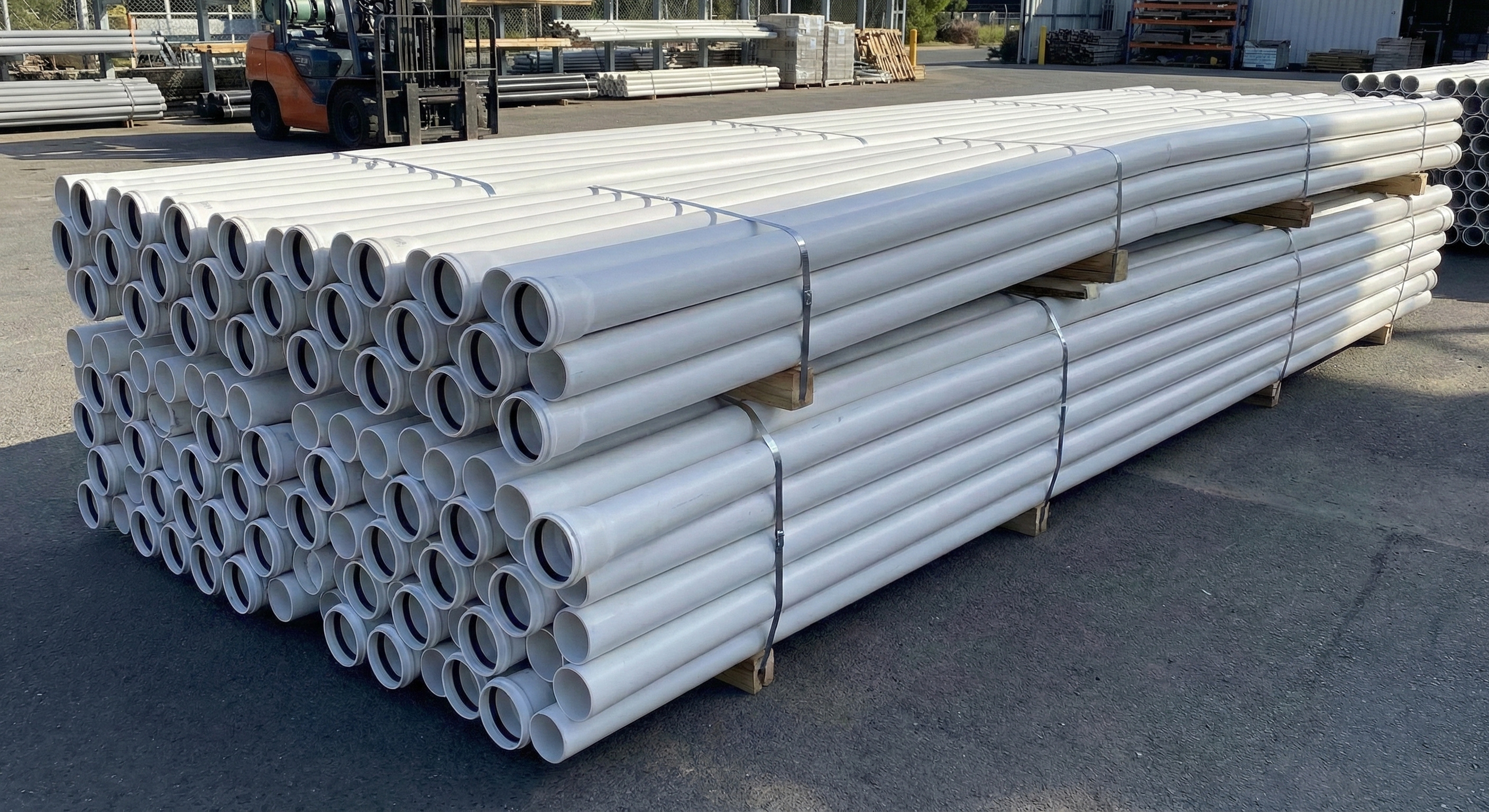
I’d optimized for the weight of each part without adding up the whole structure. It would still weigh over 500 kg, only now it would require thousands of glued tubes instead of simple plywood. The metamaterial design had not solved the mass problem; it had made the build more complicated.
That was where I stopped researching the capsule.
The Door Slammed at 2 a.m.
My sleep improved, though I never isolated the variable. Recently a door slammed at 2 a.m. I noticed. I rolled over. A year earlier, I would have stayed awake, jaw clenched.
Maybe Finland’s lower ambient stress finally settled into my nervous system7. The project may have helped too: after months of measuring and building, the noise felt less mysterious and less beyond my control.
I disassembled the cube, reclaimed the plywood, and reused the CAD skills on my next hobby project. In total I spent under 1,000 euros — about 300 on the engineer, the rest on materials and tools — and a solid month of full-time effort.
-
Decibels are logarithmic. 6 dB means roughly four times the sound energy, though your ears perceive it as only a moderate change. 10 dB is about twice as loud subjectively. ↩ ↩2
-
In a sealed capsule roughly 2 m × 0.8 m × 0.8 m (about 1.28 m³), a sleeping adult exhaling ~0.2 L/min of CO₂ would push concentration past 1% — the threshold for headaches and impaired cognition — in about 2.5 hours. Past 4–5% you risk unconsciousness. Any real build would need forced ventilation, which means holes, which means sound leaks. The leaks are solvable with a baffle box — a zigzag channel lined with absorptive material that lets air through but forces sound to bounce and die — but designing one that moves enough air quietly is a project in itself. ↩
-
Even a tiny gap dramatically undermines isolation — an opening of just 0.01% of a wall’s area can halve its effective sound blocking. ↩
-
Outer walls 45 cm, inner cavity 20 cm. Each outer wall was two sheets of 15 mm birch plywood. Inner and outer shells were decoupled with Gyproc XR 95 resilient channels — thin metal strips that flex, so the inner wall doesn’t rigidly touch the outer one. The old clothes likely reduced high-frequency absorption compared to mineral wool, but shouldn’t have affected the resonance problem. ↩
-
Measurement rig: EarFun UBOOM L speaker (chosen for its flat frequency response — important so the test signal doesn’t favor any pitch), Dayton Audio iMM-6 calibrated measurement mic, placed 1 m from the speaker at 85 ±3 dB SPL. Recorded in Audacity; TL graph generated with a Python script using the mic’s factory calibration file. ↩
-
The inner cube was 170×200×200 mm. Two acoustic modes collided at 857.5 Hz — one of the valleys on the graph. ↩
-
Moved there in 2024, before starting this project. ↩